The Future of New Clark City Depends on Nature as Much as Technology
OPINION | Letter to the Editor Posted on 2026-07-28 06:20:29
OPINION | The Future of New
Clark City Depends on Nature as Much as Technology
By the
NPO Editorial Board
The
Philippines stands at a defining moment in its pursuit of becoming a regional
leader in advanced manufacturing, artificial intelligence, semiconductors, and
digital innovation. Ambitious developments such as the proposed Pax Silica
ecosystem in New Clark City promise economic opportunities that could reshape
the nation's future. Yet, as the Philippine Rainforest Irreversibility Theory
(PRIT) framework argues, the ultimate measure of success may not be how many
factories are built or how much investment is secured, but whether the natural
systems that support those developments can endure for generations.
This
perspective deserves thoughtful consideration.
For
decades, development planning has largely focused on engineering feasibility,
financial viability, and market demand. These are indispensable factors, but
they do not answer a fundamental question: Can the environment sustain
continuous growth without reaching irreversible ecological limits? The PRIT
framework proposes that ecological carrying capacity should become an
"environmental balance sheet" against which long-term development is
measured.
This is
not an argument against industrialization.
Rather,
it is an argument for responsible industrialization.
Modern
technology industries are among the world's most resource-intensive sectors.
Semiconductor manufacturing, data centers, AI infrastructure, and advanced
electronics require reliable electricity, large volumes of water, sophisticated
cooling systems, transportation networks, and highly skilled communities. These
resources ultimately depend on healthy watersheds, functioning rivers,
resilient forests, productive soils, and stable ecosystems. As the PRIT
document notes, "every semiconductor chip ultimately depends on
nature."
The
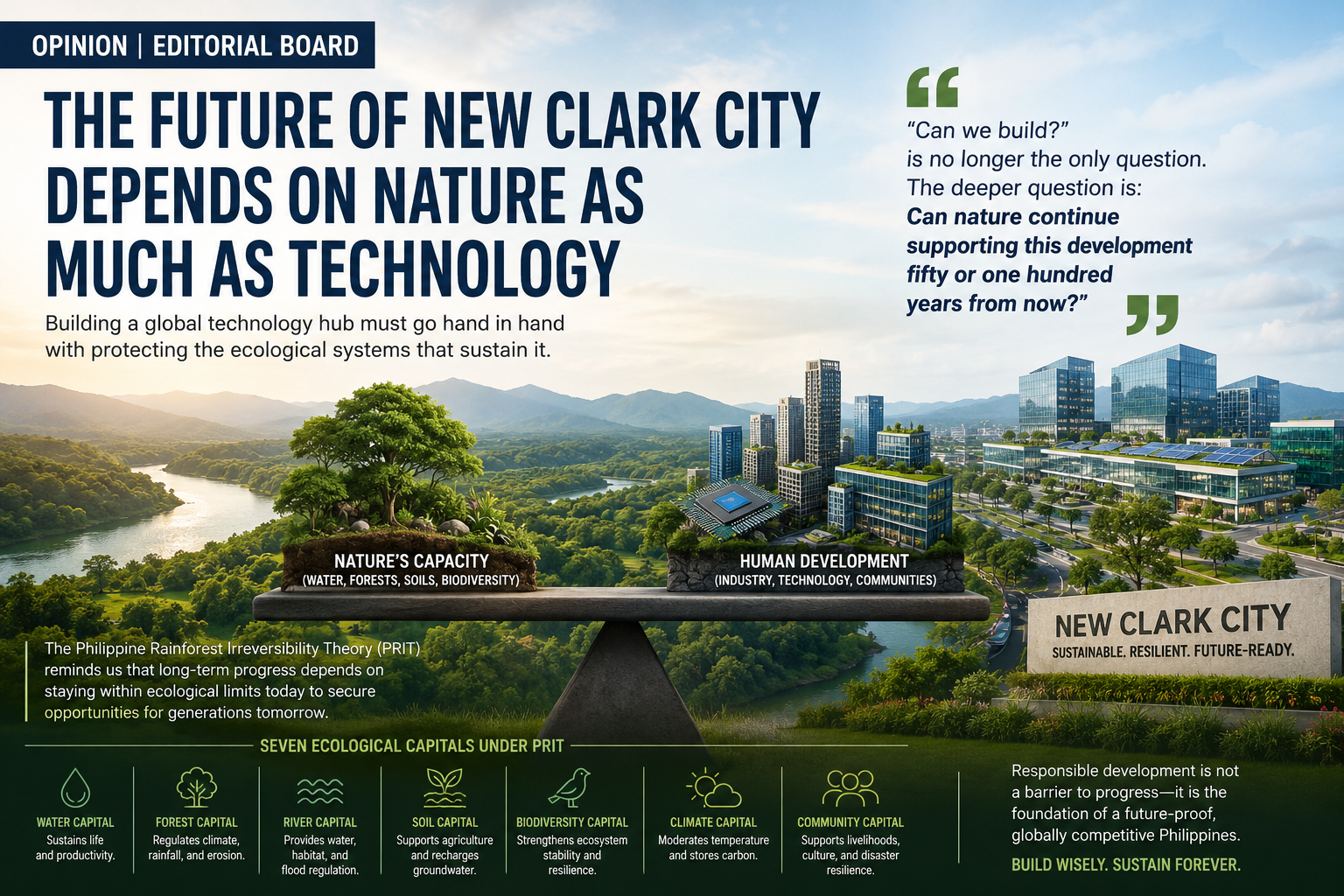
framework also introduces seven forms of ecological capital, water, forests,
rivers, soils, biodiversity, climate, and communities, as interconnected assets
that determine whether development remains sustainable over time. It argues
that weakening any of these systems may eventually increase infrastructure
costs, heighten climate risks, reduce agricultural productivity, and strain
local communities.
Whether
policymakers ultimately adopt this framework or another, its underlying message
resonates with a broader global trend. Around the world, governments and
investors are increasingly asking not only whether projects are profitable, but
whether they are resilient in the face of climate change, water scarcity,
biodiversity loss, and other environmental pressures.
The
proposal to monitor ecological thresholds, conduct watershed studies, improve
water recycling, strengthen forest protection, and involve communities in
environmental governance reflects one possible approach to integrating
environmental considerations into long-term planning. These recommendations
would require scientific validation, continuous monitoring, and coordination
among government agencies, researchers, industry, and local communities before
implementation.
Perhaps
the most valuable contribution of the PRIT framework is not that it claims to
provide every answer, but that it reframes the questions.
Instead
of asking only, "Can we build?" it encourages decision-makers
to also ask, "Can nature continue supporting this development fifty or
one hundred years from now?"
That
shift in perspective is increasingly relevant for a country as biologically
rich, and as climate-vulnerable, as the Philippines.
Economic
growth and environmental stewardship need not be competing goals. If planned
carefully, they can reinforce one another. A technology hub that secures its
water resources, protects its forests, safeguards biodiversity, and improves
the well-being of surrounding communities may ultimately prove more
competitive, more resilient, and more attractive to long-term investors than
one that overlooks those foundations.
As New
Clark City continues to evolve, the challenge is not merely to build faster or
bigger, but to build wisely. The most enduring infrastructure may not be measured
only in roads, data centers, or factories, but also in healthy watersheds,
resilient ecosystems, and communities capable of thriving alongside
technological progress.
If the Philippines aspires to become a world-class innovation economy, then ensuring that development remains within the limits of nature is not simply an environmental objective, it is a strategic investment in the nation's future.
NPO Editorial Board
Share:
Writer :
Link :
Leave a Comment:
Date: Wednesday | October 7, 2026 | 12:46:am
Sections
Recent News
RECENT POSTS
CDA MIMAROPA Empowers Cooperative Leaders to Lead the Digital Transformation and AI Era
Category : AGRI-NEWS
Read More →