Philippine Cities Eye Smarter Future Through Integrated Waste Segregation and Circular Economy Solutions
News | Environment Posted on 2026-07-23 04:02:01
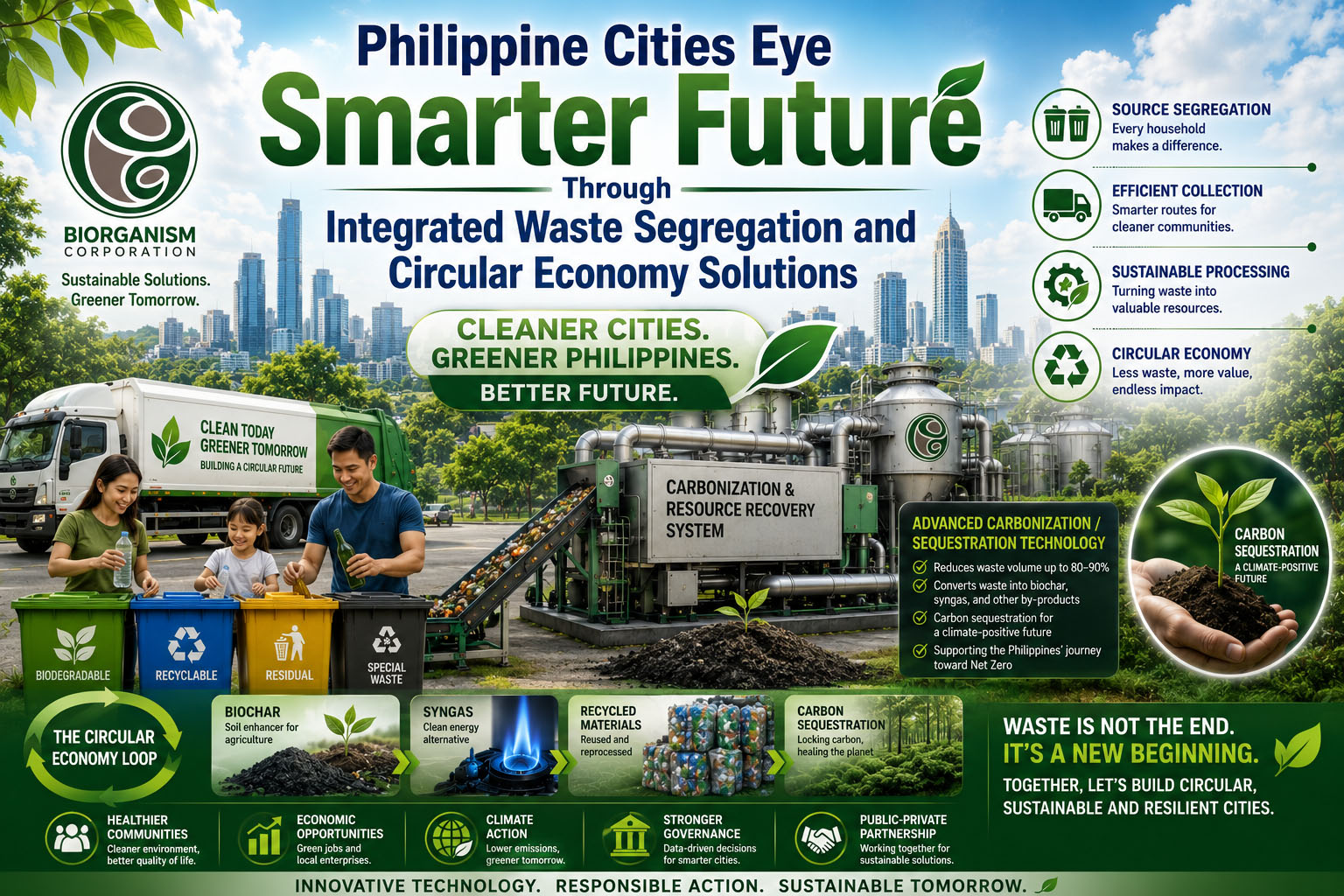
A New Vision Seeks to Transform Garbage from an Environmental Burden into Valuable Economic Resources
MANILA, Philippines — As major cities across the
Philippines continue to face mounting challenges from increasing volumes of
municipal solid waste, a new integrated waste segregation and resource recovery
approach is being proposed to help local government units (LGUs) move toward
cleaner, healthier, and more sustainable communities.
The proposal highlights a simple but powerful
principle: waste is not the problem—mixed waste is. When garbage is
properly segregated at its source, much of what is traditionally discarded can
instead become valuable raw material for agriculture, manufacturing,
construction, and environmental restoration.
According to the feasibility study prepared by Biorganism
Corporation and BB 88 Advertising and Digital Solutions Inc.,
approximately 52.31% of municipal solid waste in the Philippines
consists of biodegradable materials, while 27.78% is recyclable, leaving
only a relatively small residual portion requiring final disposal. The study
emphasizes that effective segregation combined with resource recovery
technologies could substantially reduce landfill dependence while creating
economic opportunities. Development of a 1-Ton Integrated Carbonization Waste
Management System.
A Shift from "Waste Disposal" to
"Resource Recovery"
The
proposed system encourages cities to move beyond the traditional
"collect-and-dump" model by introducing an integrated process that
includes:
- Source waste segregation in
households, schools, businesses, and public markets.
- Digital collection and
monitoring systems using GPS and RFID technologies.
- Centralized sorting and
material recovery facilities.
- Carbonization of
biodegradable waste into biochar and carbon-based soil conditioners.
- Recycling of plastics into
construction materials where technically validated.
- Recovery of glass and metals
for industrial recycling.
- AI-supported monitoring and
data-driven waste management. Development of a 1-Ton Integrated
Carbonization Waste Management System - By Biorganism Corporation.pdfPDF
Rather than viewing garbage as an environmental
liability, the proposed framework treats waste as a renewable resource capable
of generating employment, reducing pollution, and supporting local industries.
Waste Segregation: The Foundation of Cleaner Cities
The proposal underscores that waste segregation is
the most important first step toward solving the country's growing waste problem.
Food waste, agricultural residues, garden waste,
paper, plastics, metals, and glass each require different treatment methods.
When mixed together, valuable recyclable materials become contaminated,
processing costs increase, and larger volumes of waste end up in already
overburdened landfills.
The study notes that effective segregation allows
biodegradable materials to be converted into products such as biochar, compost,
or soil conditioners, while plastics, glass, and metals can be recovered for
recycling, helping municipalities divert a significant share of waste away from
disposal sites. Development of a 1-Ton Integrated Carbonization Waste
Management System.
Supporting the Circular Economy
The
proposed system embraces the principles of the circular economy by keeping
valuable materials in productive use rather than sending them to landfills.
Instead
of a linear cycle of: Consume → Throw
Away → Landfill
the
proposal promotes: Segregate →
Recover → Recycle → Manufacture → Reuse
Under
this approach:
- Organic waste can become
agricultural soil amendments through carbonization.
- Plastic waste may be
processed into construction products, subject to technical validation.
- Glass and metals are
returned to manufacturing supply chains.
- Digital technologies help
optimize collection, logistics, monitoring, and reporting. Development of
a 1-Ton Integrated Carbonization Waste Management System.
Environmental and Community Benefits
The
feasibility study outlines several anticipated benefits if integrated waste
segregation is widely adopted:
- Reduced landfill disposal
volumes.
- Lower methane emissions from
biodegradable waste.
- Cleaner rivers, esteros, and
coastal environments.
- Reduced flooding caused by
clogged drainage systems.
- Improved public sanitation.
- Increased recycling rates.
- New employment opportunities
in collection, recycling, and resource recovery industries.
- Longer operational life for
sanitary landfills. Development of a 1-Ton Integrated Carbonization Waste
Management System.
A Pilot Toward Scalable Solutions
The proposal also presents a PHP 21.5-million
Proof of Concept for a 1-Ton Integrated Carbonization Waste Management
System. The pilot integrates waste collection, automated sorting,
carbonization, recycling, and digital monitoring to demonstrate the technical
and operational feasibility of a resource recovery model that could later be
adapted for larger cities, industrial parks, and regional waste management
hubs. Development of a 1-Ton Integrated Carbonization Waste Management System.
The concept aims to process mixed municipal waste
through a combination of mechanical sorting and controlled carbonization, while
recovering recyclable materials and producing value-added products such as
biochar, carbon soil conditioners, recycled construction materials, and
recovered metals and glass. Development of a 1-Ton Integrated Carbonization
Waste Management System.
Building Cleaner and More Resilient Philippine
Cities
As Philippine cities continue to grow, effective
waste management is increasingly recognized as a key component of urban
resilience, environmental protection, and sustainable development.
The proposed framework aligns with existing
Philippine environmental policies, particularly the Ecological Solid Waste
Management Act (Republic Act No. 9003), while encouraging stronger
implementation through improved segregation, education, digital technologies,
and resource recovery systems. Development of a 1-Ton Integrated Carbonization
Waste Management System.
Supporters of the proposal emphasize that achieving
cleaner cities will require collaboration among local governments, communities,
businesses, educational institutions, and environmental stakeholders.
By transforming waste into valuable resources
rather than simply disposing of it, Philippine cities have an opportunity to
advance toward a cleaner environment, stronger local economies, and a more
sustainable future for the next generation.
Source: Feasibility Study on the Importance of Waste Segregation in Addressing the Growing Waste Management Problem in Major Cities of the Philippines and Proof of Concept: Development of a 1-Ton Integrated Carbonization Waste Management System, prepared by Biorganism Corporation and BB 88 Advertising and Digital Solutions Inc.
NPO NEWS TEAM I BC-PR
Share:
Writer :
Link :
Leave a Comment:
Date: Monday | August 17, 2026 | 9:58:pm
Sections
Recent News
RECENT POSTS
PhilJaps Team Unites Filipino and Japanese Experts to Turn Waste Into Livelihood and Strengthen Food Security
Category : News
Read More →
PhilHealth Leads Multi-Sector Push to Accelerate Universal Health Care Reforms
Category : News
Read More →
FISMPC Opens a New Digital Era as Members Rally Behind Innovation and Cooperative Transformation
Category : Technology
Read More →