DOST Unveils Vision of an AI-Driven Philippines by 2028
Technology | Innovation Posted on 2025-10-18 05:35:20
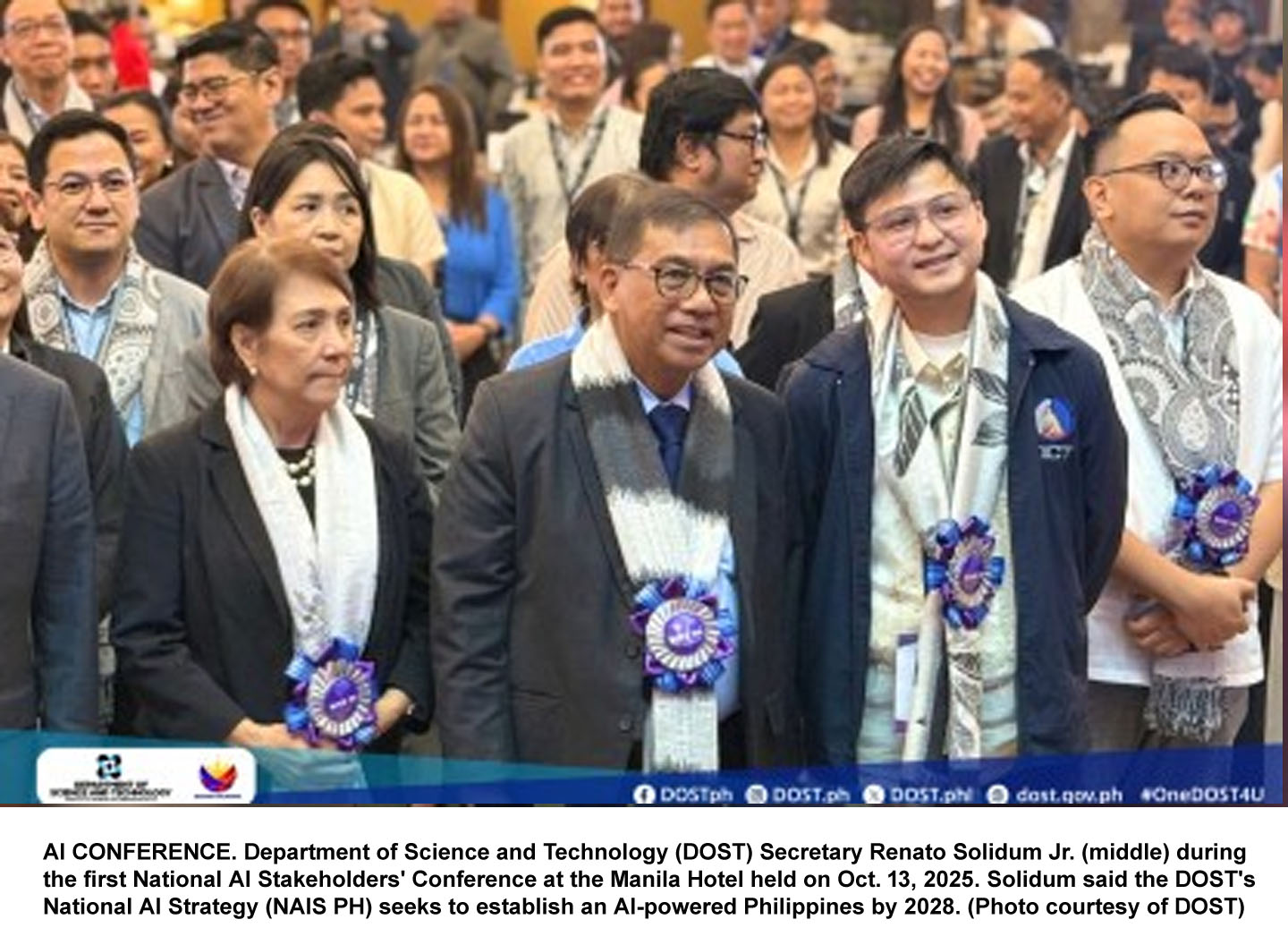
MANILA – The Department of Science and Technology (DOST) is charting a bold course toward transforming the Philippines into an artificial intelligence (AI)-powered nation by 2028, under its flagship National AI Strategy (NAIS PH) project.
At the National AI Stakeholders’ Conference held at the Manila Hotel on October 13–14, DOST Secretary Renato Solidum Jr. said the initiative aims to establish a strong digital foundation that will harness AI for inclusive growth and sustainable national development.
“The National AI Strategy envisions an ecosystem built on robust infrastructure, a future-ready workforce, ethical governance, and cutting-edge research and innovation,” Solidum said. “Through this, AI will become a true public good—improving lives, expanding opportunities, and enabling a sustainable, tech-empowered future for every Filipino.”
Solidum highlighted that AI is already revolutionizing several sectors in the country, including transportation, finance, creative industries, energy, environmental management, defense, and public security. The DOST, he added, has invested over ₱2.3 million in 113 AI-related projects, affirming confidence in the Filipino mind’s ability “to create, not just consume technology.”
The Philippines’ AI roadmap was first introduced in 2017 through a collaboration among the DOST, Department of Trade and Industry (DTI), Department of Education (DepEd), and various private-sector partners. Since then, the government has trained AI researchers through the DOST Summer School for AI, developed high-performance computing infrastructure, and funded AI R&D programs under DOST-PCIEERD (Philippine Council for Industry, Energy and Emerging Technology Research and Development).
The DOST and DTI have also launched their respective AI roadmaps to guide national priorities, while DepEd has established an Education Center for AI Research to promote AI literacy and integration in basic and higher education.
To achieve an AI-powered Philippines by 2028, NAIS PH outlines five strategic pillars:
-
Infrastructure Development – Building computing and data centers for AI research and applications.
-
Workforce Development – Training 10,000 AI-capable professionals to deploy industry-ready AI solutions.
-
Innovation Support – Encouraging startups and universities to transform ideas into real-world applications.
-
Data Governance and Policy – Promoting ethical, transparent, and accountable AI use.
-
Deployment and Integration – Expanding AI adoption in public and private sectors.
“This framework ensures coherence and accountability, where every agency plays a defined role in advancing AI that is ethical, sustainable, and inclusive,” Solidum explained.
The Philippine AI Implementation Framework seeks to foster a collaborative ecosystem linking government agencies, academia, startups, and international partners. Solidum described this as creating “AI refineries and factories” — innovation hubs where ideas become solutions in healthcare, education, agriculture, and climate resilience.
On workforce development, DOST plans to scale up AI education through micro-credentials, continuing education programs, and online learning platforms like Sparta and Coursera, enabling rapid, accessible training for Filipinos nationwide.
“The ultimate goal,” Solidum concluded, “is to make the Philippines a hub of AI excellence—where technology empowers, protects, and uplifts every Filipino.”
Courtesy of the Department of Science and Technology (DOST) | NPO News Team | PNA-PR
Writer :
Link :
Leave a Comment:
Date: Monday | February 23, 2026 | 9:32:pm
Sections
Recent News
RECENT POSTS

DA, DOT Seal Partnership to Elevate Farm Tourism and Promote PH as Food Destination
Category : AGRI-NEWS
Read More →
DA Turns Over PHP96.35-M Farm Aid Package to Boost Kalinga Agriculture
Category : AGRI-NEWS
Read More →
Eala Advances to Dubai Second Round After Baptiste Retires Due to Injury
Category : Sports
Read More →
BB 88 Advertising and Digital Solutions Inc. Welcomes Its Largest Internship Batch Yet, Empowering Over 80 Future Filipino IT Professionals in 2026
Category : Technology
Read More →